The 4-Pillar AI Framework for SMBs and Mid-Market Companies: From Experimenting to ROI
Most business owners feel like they're falling behind. You see headlines about AI changing everything, but when you try to use it, you're often left with a handful of ChatGPT subscriptions and no real change in your bottom line. The problem isn't the technology. It's the lack of a framework for making it stick.
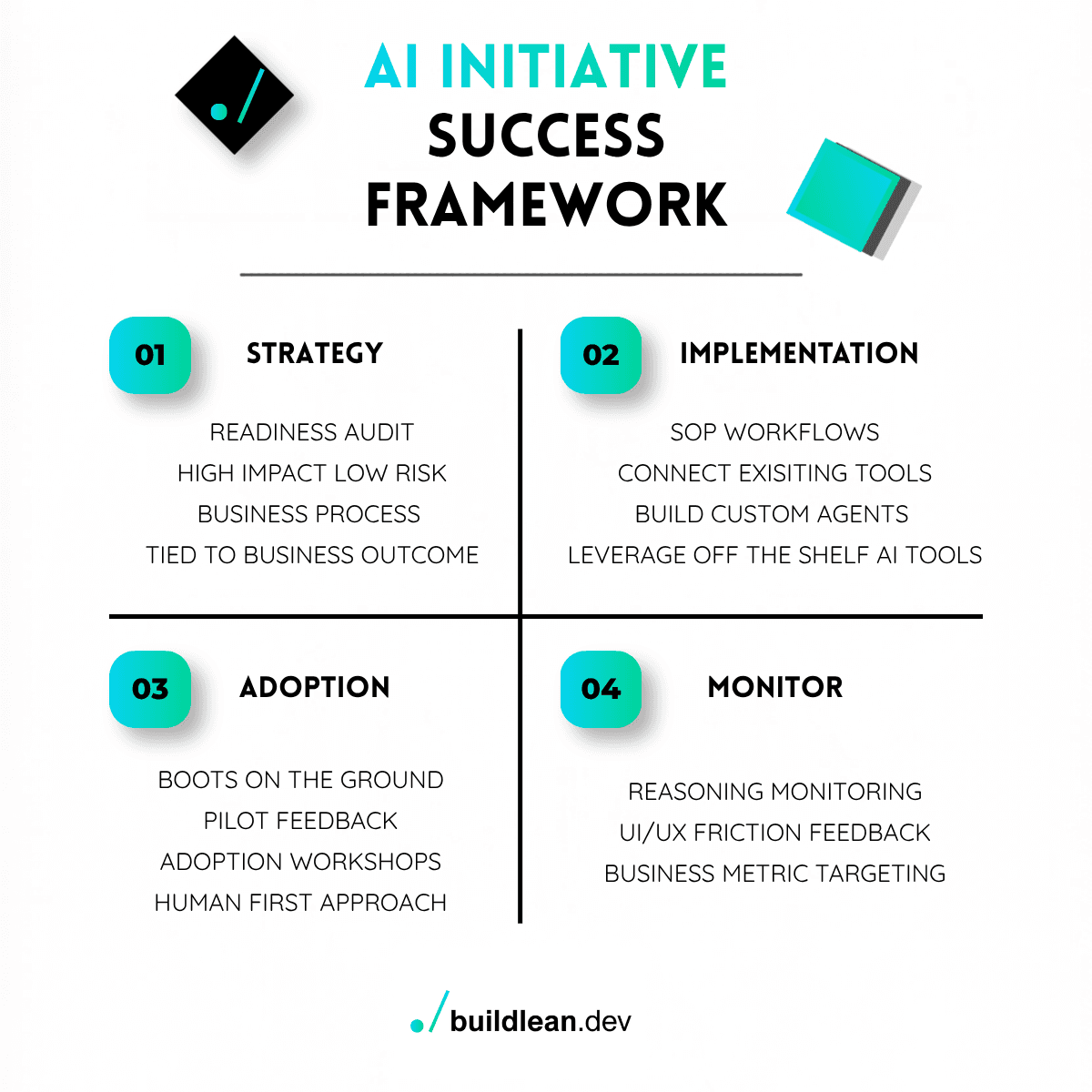
At BuildLean, we've seen that AI success isn't about having the smartest algorithm. It's about how that algorithm fits into your daily operations. To move from 'playing with AI' to 'profiting from AI,' you need a structured approach. We use a four-pillar framework designed specifically for small and mid-sized businesses to ensure technology investments actually pay off.
Pillar 1: AI Strategy (The Readiness Audit)
You shouldn't start by building something. You should start by auditing what you already have. We see too many founders jump into development without a clear target. A successful AI strategy focuses on finding high-impact, low-risk business processes that are tied directly to a business outcome.
What does 'high impact' look like? It's usually the boring stuff. Think about the manual data entry your team does for six hours every Monday, or the repetitive client questions that clog up your inbox. These are the prime candidates for automation because the cost of a mistake is low, but the time saved is massive. You can learn more about how we evaluate these opportunities on our Why BuildLean page.
A readiness audit isn't just about the tech; it's about the data. Does your team keep clean records? Are your workflows documented? If your current process is a mess, AI will only help you make a mess faster. We identify the gaps before a single line of code is written.
Pillar 2: Implementation (Workflows and Agents)
Implementation is where the strategy becomes real. This isn't just about 'installing' AI. It involves mapping out your Standard Operating Procedures (SOPs) and figuring out how to connect the dots. Most businesses already have a tech stack—a CRM, a project management tool, an accounting platform. The goal is to make AI the glue that holds them together.
We typically look at three levels of implementation. First, we connect existing tools using automation platforms. Second, we leverage off-the-shelf AI tools for specific tasks like transcription or content drafting. Third, we build custom AI agents for proprietary workflows that off-the-shelf software can't handle. This tiered approach ensures you aren't overspending on custom software when a simpler solution exists.
The secret to a good implementation is that it feels invisible. Your team shouldn't have to learn a complex new language to get work done. The AI should meet them where they already are—whether that's in Slack, email, or your existing dashboard.
Pillar 3: Adoption (The Human-First Approach)
You can build the most advanced AI agent in the world, but if your employees are afraid it will replace them, they'll find reasons to ignore it. Adoption is the most neglected pillar. It requires 'boots on the ground' to gather feedback and run workshops that show the team how the tool makes their lives easier, not harder.
We recommend starting with a pilot group. Find three or four people in your company who are tech-curious and let them break things. Their feedback is more valuable than any developer's opinion. Use their wins to create internal case studies. When the rest of the staff sees that 'Dave from Sales' is closing twice as many deals because he's not stuck doing paperwork, they'll want in on the action.
Training shouldn't be a one-time event. It’s an ongoing conversation. We've found that human-first adoption workshops help dismantle the 'AI fear' and replace it with a 'superpower' mindset. Your team is your best source of ideas for what the AI should do next.
Pillar 4: Monitoring (Reasoning and Friction)
The work doesn't end when the tool is deployed. In fact, that's just the beginning. AI is probabilistic, not deterministic. That’s a fancy way of saying it can sometimes make things up. Pillar four is all about monitoring the 'reasoning' of your AI models to ensure they stay on track and don't hallucinate.
We also look closely at UI/UX friction. If a team member has to click five buttons to get an AI summary, they’ll eventually stop doing it. We monitor how the tools are actually being used and simplify the interface based on that data. If people are dropping off at a certain step, that’s where the friction is.
Finally, we circle back to the business metrics identified in Pillar 1. Are we actually saving those 10 hours a week? Is the lead conversion rate higher? If the metrics aren't moving, we pivot. Constant monitoring ensures your AI initiative remains an asset rather than a line-item expense.
Ready to build? Book a free discovery call and let's talk about your project.
Share this article
Get Started
Let’s talk about your business.
Bring your questions, your current challenges, or an idea you’re exploring. In a free 30-minute call, we’ll discuss what you want to improve and where Build Lean could help.